Saturday, September 21, 2013

We Threshed and Winnowed the Wheat!

We were very busy after school on Monday September 16th! Our friend, Brittany, was over to visit and the weather was good, so we did some "wheat work".
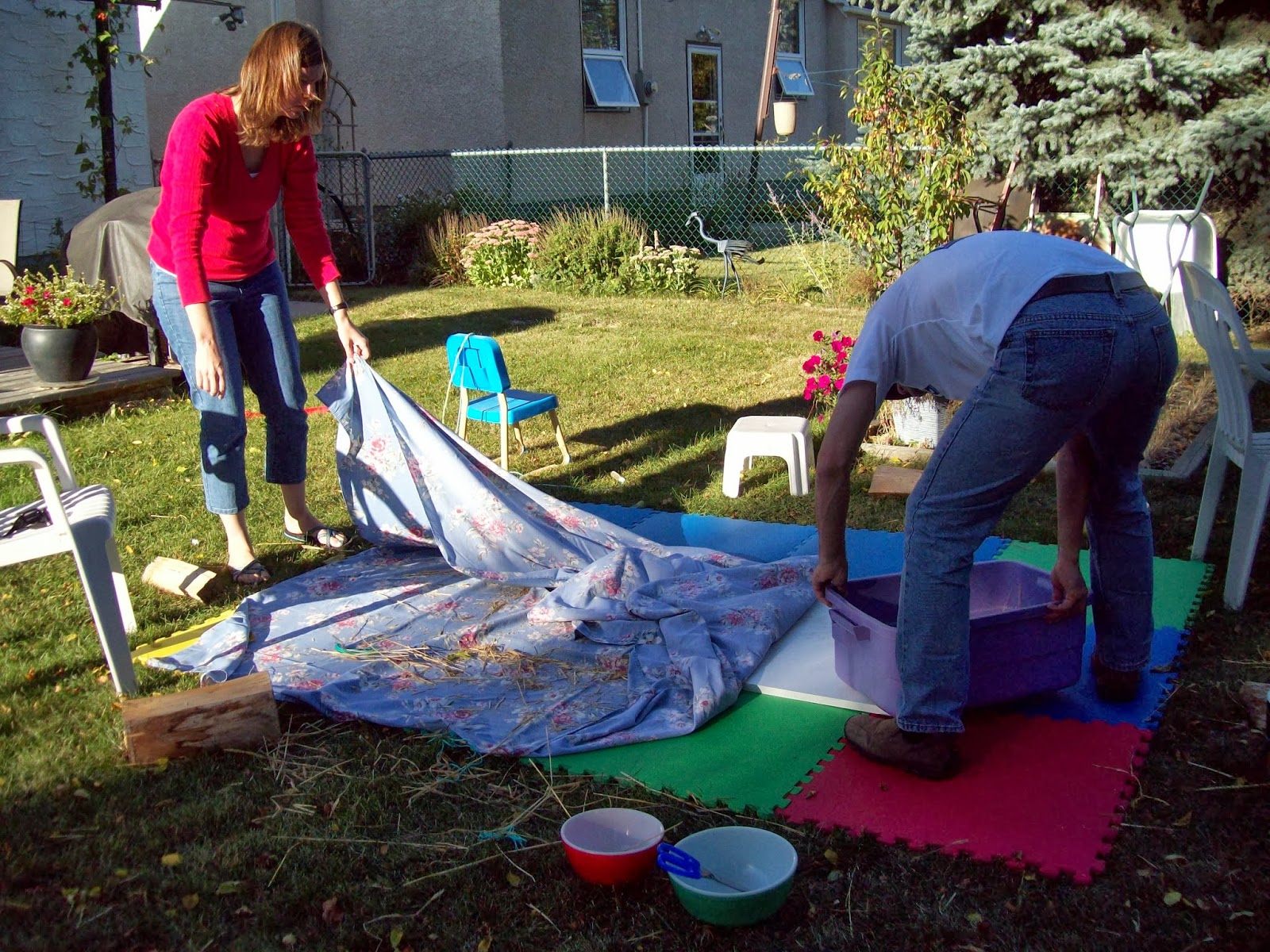
Time to make a threshing floor!
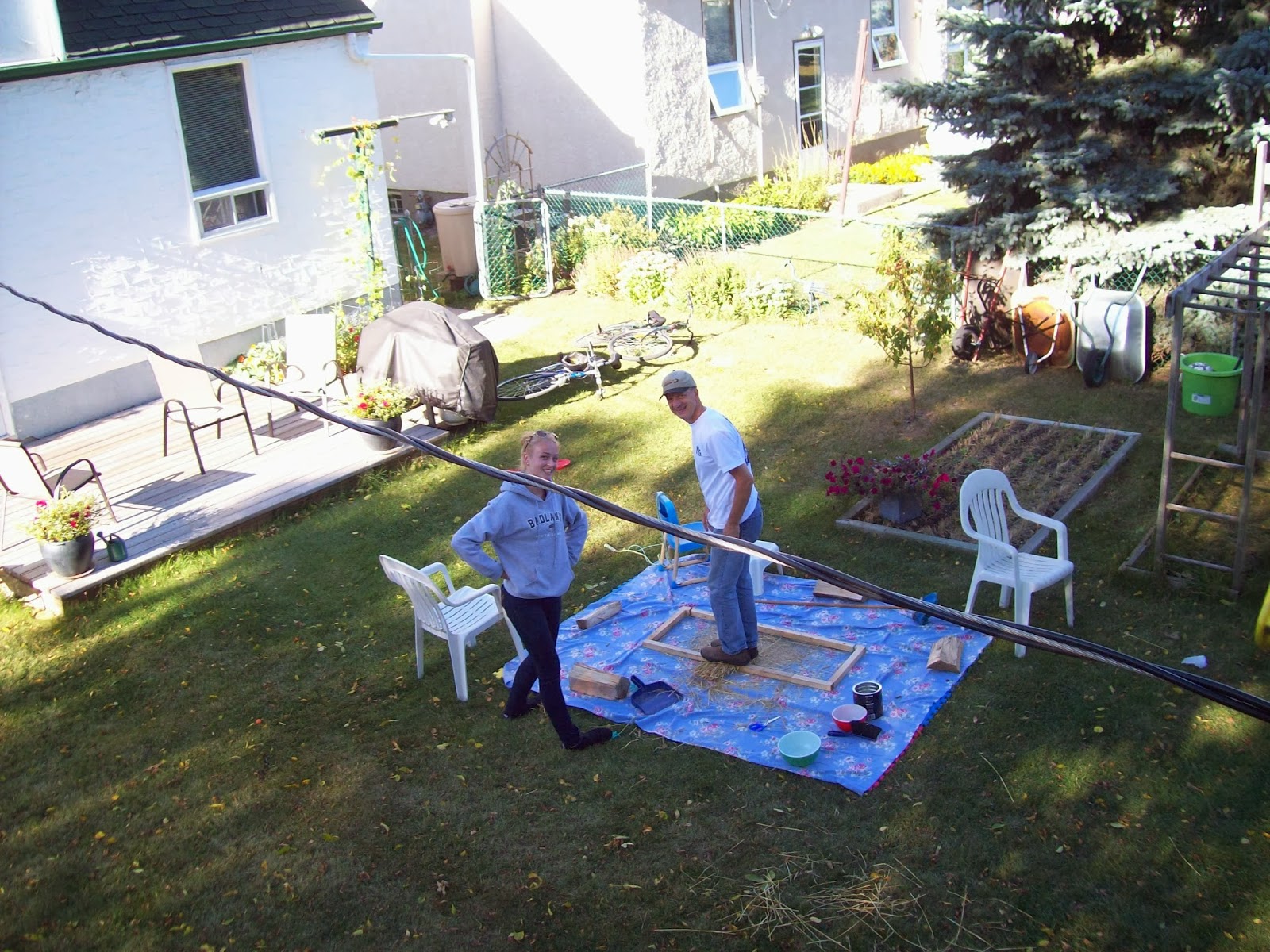
We used a piece of wood from the garage and a few old play mats to set up a hard and clean spot in the yard. Then we covered it with a bed sheet, and held it in place with some chairs and wood, since it was a windy day.
We got the idea to use some wire fencing (it is also called hardware cloth) from a YouTube video by John Jeavons all about threshing. We watched a few other videos with other methods, but this one looked like it would work the best for us. Here is the link: https://www.youtube.com/watch?v=3FXNCNSkdaM&feature=youtube_gdata_player
A section of our garden fence worked as a threshing screen.
We also knew that we would need shoes with flat bottoms for this, since we were getting ready to stomp on the grain and we didn't want to get it stuck in our shoes.
Flat-bottomed shoes for threshing, please!
With the screen in place on the threshing floor, we didn't need to separate the straw from the heads, we just placed the heads over the screen, stepped on the straw, and started a little shuffle on the wheat to do the threshing.
Julia places the wheat...
...and starts doing the "Wheat Dance"!
Our method worked pretty well, but it was a bit hard to balance on the edge of the screen sometimes. We all took turns, and the threshing took about an hour from start to finish.
An action shot of our threshing machine!
After we threshed a sheaf or two, we removed the screen, separating the straw from and some of the chaff from the grain. Then we simply swept up the wheat, and repeated the process until all seven of our sheaves were threshed.
It looked like this when we removed the screen.
...and then we swept it up and kept going!
Heather's Turn!
Thresh, Heather, Thresh!
From the treehouse you can see the "field" too, behind the white chair.
Brittany's turn to thresh!
We got good enough to thresh two at a time!
After a while we really started to realize how much work it is to thresh wheat. Our system was working well, but it took an awful lot of "Wheat Dancing" to get through those seven sheaves!
UGH! This is a LOT of work for one loaf of bread!
Finally we removed the screen for the last time and got to start cleaning up. With four of us threshing it really took about an hour, but we worked pretty hard for that hour!
With the threshing all done we emptied whatever was left on the sheet into our bin, and that also helped us to get every piece of wheat (and to keep the seeds off of the lawn too!).
All threshed! Time to winnow!
We were wondering how long it would take us to clean all of the straw and husks off of our threshed wheat. It was a windy day, and after we took a bit of a break we decided to winnow the wheat, since we still had sunlight, and it was pretty windy out. Most people use a fan to winnow, and we would have done that too, but the wind worked just fine.

Winnowing is a lot of careful pouring. The wind blows away the chaff.
After winnowing the wheat about five times.
After winnowing about ten times...getting pretty clean!
This week we have been drying the grain, and cleaning it. The grain should be at about 12% humidity (inside the grains) before we try to grind it into flour. We have no idea how to measure that, so we'll just dry it out for now. If the grain starts to stick together or gum up when we try to grind it then we will know it is still not ready. We also have to figure out a quicker method for drying. Right now we just have it sitting in a warm room on cookie pans.
Cleaning and drying the harvest.
Final cleaning, on Saturday September 21, 2013.
While the wheat is drying we have to figure out how we will grind it into flour. This process is also called "milling". We have read a few ways we could try, but we have not settled on a method yet. Hopefully the grain will be dry enough when it comes time!

We have not yet weighed our grain yet to figure out how much we yielded from the 4x8 field we planted. We do know that it fills up 2/3 of a large Peanut Butter jar. Maybe we will weigh it properly next week. We also don't know how much flour it will make, or what recipe we ought to use for the bread when we get there.

We are getting close though!

And that is all we know so far.

Sunday, August 25, 2013

We Harvested the Wheat!

Saturday, August 24th was a beautiful sunny day, and since it was 91 days since the wheat emerged we decided to harvest it.
Ready For Harvest!
We asked a local farmer for advice about when to harvest. He told us that the wheat would be ready to harvest when we could easily separate the seed by rubbing it in our fingers and having it crack and crunch like a nut when we chewed it. We tried that test a few times, and at the start it was still too green, and the seed would squish instead of cracking. By August 24, the seed was good and dry for harvest.
Finding the seed in the husk

Since our field is so small (32 s.f., or 4x8 feet) we kept the harvesting method really simple...shears and scissors! No combines, no sickles, and no scythes. Kitchen scissors proved to be the best tool for us. We hand-tied each sheaf (or bundle) of wheat with some yarn.
Starting the harvest with grass shears.

These were the best harvest tools for us!
The harvest took us about 40 minutes from the time we started until we had our seven sheaves of wheat.


It was fun cutting the wheat. We were surprised to find out that it was hollow on the inside! Then Mom reminded us that "straws" for drinking are like wheat straw, both are hollow on the inside!

Three rows done, four rows to go!
We made our sheaves using some yarn. Each sheaf got 12 wraps of yarn and then got tied up. Each sheaf was just big enough for an adult to grip with one hand. Looking at all of it bundled makes us wonder just how much flour we will get in the end...it could be a really little loaf of bread, but we will have to wait and see!
Tying off a sheaf. We harvested 7 sheaves in total.
Once the harvest was done it was a bit odd to look back at the stubble field...kind of like looking at a really furry dog right after a super short hair cut. We still are not sure what to do about the stubble. Do we turn it under? Ignore it? We know that many farmers in our region burn their stubble, but we won't be doing that!
All done, but now what do we do with the stubble?
We all found that it was fun to stand, run, and stomp on the stubble after having been so careful about our little field since April.
Having FUN in the stubble!
Once we had the sheaves it was fun taking a few pictures with them, and then Dad figured out a way to hang the seven sheaves in the garage, since they have to dry for a while yet before we figure out how to thresh the grain and how to winnow it.


Our harvest, hanging from the rafters in the garage.
Now the wheat will have to dry for a while and we have to do some research to figure our how to separate the seeds from the stalks. Threshing and winnowing are the processes. Ancient cultures used a large flat rock area for threshing and the wind for winnowing. We will have to figure out a threshing floor of our own.

It is exciting to get this far in the process, and we are getting closer than ever to our loaf of bread!

And that is all we know so far.

Friday, August 2, 2013

Let it Grow, Let it Grow, Let it Grow!

Happy New Month! August is here, and Saturday August 3rd marks 70 days since we first saw the baby wheat poking out of the ground. From what we have found out it should be ready to harvest between 90 and 100 days, which will be Labour Day Weekend.
Starting to change from Green to Gold!
Grandpa Laurie was by the other day to check out the wheat. He figures that the beards on our wheat are bigger than the ones he remembers as a kid on the prairies. Maybe it is because there are different kinds of wheat, and they all look a little bit different from one another.
Measuring up
The wheat now stands between 80cm and 90 cm tall. That's about 32 to 35 inches or so for those who get inches more than centimetres. In a big rain shower the wheat gets heavy and flops over, and the first time it did this we were worried it would stay down, but it didn't. After the sun and wind dry it out it stands back up again. We noticed that we are not the only ones minding the wheat either...the ants seem to like it!
Why do the Ants like the Wheat?
We know that the ants like our peonies and that they help to open the flowers, but seeing the ants in the wheat is a bit of a surprise. No other insects or spiders seem to hang around in the wheat like the ants do. Are they finding something to eat in there?
Neat to see it wave around in the wind too.
The wheat sure looks different than it did when it first emerged as tiny blades of grass. And the yard looks really different from when we started this project on April 20th. There was still snow on the ground! Pretty soon we have to figure out about harvesting, stooking, drying and those steps. Right now we just have to hope for good growing weather for another 30 days. Grow wheat grow!

That is all we know so far.

Wednesday, July 3, 2013

The Wheat has Grown Heads!

On July First we were looking at the field when we got a surprise: THE WHEAT HAS HEADS!!! Some of our wheat started to look like the wheat you might see on a calendar of the Canadian Prairies.
Field Inspection on July First (Canada Day)
Look- it has a head! (Really a "Spikelet")
The heads of wheat are actually called "spikelets". We found this out when we phoned Uncle Paul to tell him about the wheat. Since "spikelet" is a bit weird sounding to us we're just going to call them heads for now. The heads appeared on day 37 after emergence. This seems early measuring against the Feekes Scale, but maybe this kind of wheat just grows faster. We took a few more photos, just for fun:
Three Heads are better than one!

I wonder how this will taste?
The head seems to split the stalk and pop out.

The Flag Leaf ends up off to the side.
Since the wheat is taller now and the heads are so neat to see we decided to take down the bunny fence. The bunnies usually eat smaller things that are closer to the ground so the wheat should be ok now. We are wondering when it will change colour to a golden yellow, and how much taller it will get over the next month or two.
Taking down the bunny fence.
The fence seemed longer stretched out in one line!
Weeding and filling the post holes.

Finding weeds in the middle rows.
...and weeding the edges too!
 So far it seems like the wheat is growing well. In a few days it looks like all of the wheat will have heads, and then it just has to keep growing. We will have to figure out how to tell when to harvest it, but we have time before then. It really is amazing to think about how much goes into making a loaf of bread...we are still just getting started!
Ta Daa! Look! A baby wheat field in our back yard!
Now we weed, wait, and watch. Seeing the fireworks on Canada Day was pretty awesome, but seeing the heads on our wheat was even more awesome! It really doesn't look like long grass any more, we really do have a little wheat field in our back yard.

And that is all we know so far.